How Long Does It Take You to Answer "How Much Cash Do We Have?"
April 27, 2026
Every small company has a version of this story.
A Tuesday morning, fifteen minutes before a call. Someone on our team needed a number. How much cash do we have across all our accounts, in IDR, right now.
The answer took 25 minutes. Three banking portals, two spreadsheets, a fair bit of copy-paste. Nothing was broken. The information just lives in different places, in different currencies, and nobody has time to keep a master sheet current.
At Oddbit, we ship software for a living. And we spent half an hour on a question a junior bookkeeper could have answered on paper in 1995.
The problem isn't new, but we've stopped noticing it
If you run a small or mid-sized company, especially one that takes payments in more than one currency, you probably have some version of this setup.
A primary business bank account. One or two secondary accounts, maybe in a different country or currency. A payment platform like Stripe, Wise, Airwallex, or a regional equivalent. An invoicing tool that sort-of-but-not-really tells you what's paid. A spreadsheet that someone updates when they remember to.
Each of those systems has a login. A dashboard. A slightly different definition of "balance." One reports in USD. Another in SEK. Airwallex will convert for us, but only after a couple of clicks. Stripe shows a gross number that doesn't match what lands in your bank. Your accountant's spreadsheet is accurate on the first of the month and stale by the third.
None of this is dramatic. Each tool works fine on its own. The problem is only visible when you try to answer a simple question that touches all of them at once.
Questions like these.
- How much cash do we have right now, in our reporting currency?
- Which client hasn't paid yet, and how far behind are they?
- Did that transfer from last Tuesday actually clear?
- How much did we spend on contractors this month?
- If the SEK-to-EUR rate moves 3%, what does that do to our runway?
These aren't exotic questions. They are the questions a CEO or CFO asks every week. And the honest answer, for most small companies, is: I'll get back to you tomorrow.
We didn't notice how weird that is
What we've accepted, as founders and operators, is the idea that real-time financial visibility is something that lives in the gap between their banking portals and their bookkeeper.
That is a strange thing to accept. We have real-time data on website clicks, visitors, ad spend, and product usage. We have dashboards for things that don't affect our daily operations. But the answer to "how much money do we have" requires opening five tabs and doing math in our heads.
The reason isn't that the data is hard to get. Most modern banks and payment platforms have APIs. The data is sitting there, in structured form, waiting to be queried. The reason we don't query it is that stitching those feeds together is nobody's job. Engineering doesn't do it, because it's finance. Finance doesn't do it, because it's engineering. So it doesn't get done.
The quiet tax
Nobody lists "wasted time in banking portals" as a line item. It doesn't show up in the P&L. But it is there, and for a small leadership team it adds up to something real.
Rough shape of it, at a 10 to 30 person company.
The CEO or CFO spends 30 to 60 minutes a week reconciling balances across accounts. Board prep week doubles that, because everything has to be cross-checked. Every late invoice gets chased twice, because no one is certain whether it was paid. Month-end takes a day longer than it should, because the real numbers are always one sync behind.
And then there's the moment no one prepares for. An investor asks a pointed question on a call, mid conversation, and they want a number now. Not tomorrow. Not after you've opened your portals. The kind of question where hesitating too long already tells them something. How much runway do we have at the current burn? What's our receivables position? If you can't answer with confidence in the moment, the meeting has shifted, and not in your direction.
Call it four hours a week of senior time, spent doing something a well-built tool could do in the background. In a company that charges out at hundreds of euros an hour, the cost isn't the hours. The cost is the decisions you don't make, because you don't have the numbers in front of you when you need them.
We noticed this because we were living it.
This is actually just how we work
There is a pattern at Oddbit that comes up again and again.
We spot a gap. We say something. And if we have the time and the curiosity, we build the fix ourselves and use it.
We did this with Shrtnr, a URL shortener we built because the existing ones didn't integrate with our AI workflow. We also did it with a tool for our finances. We call it Rekap.
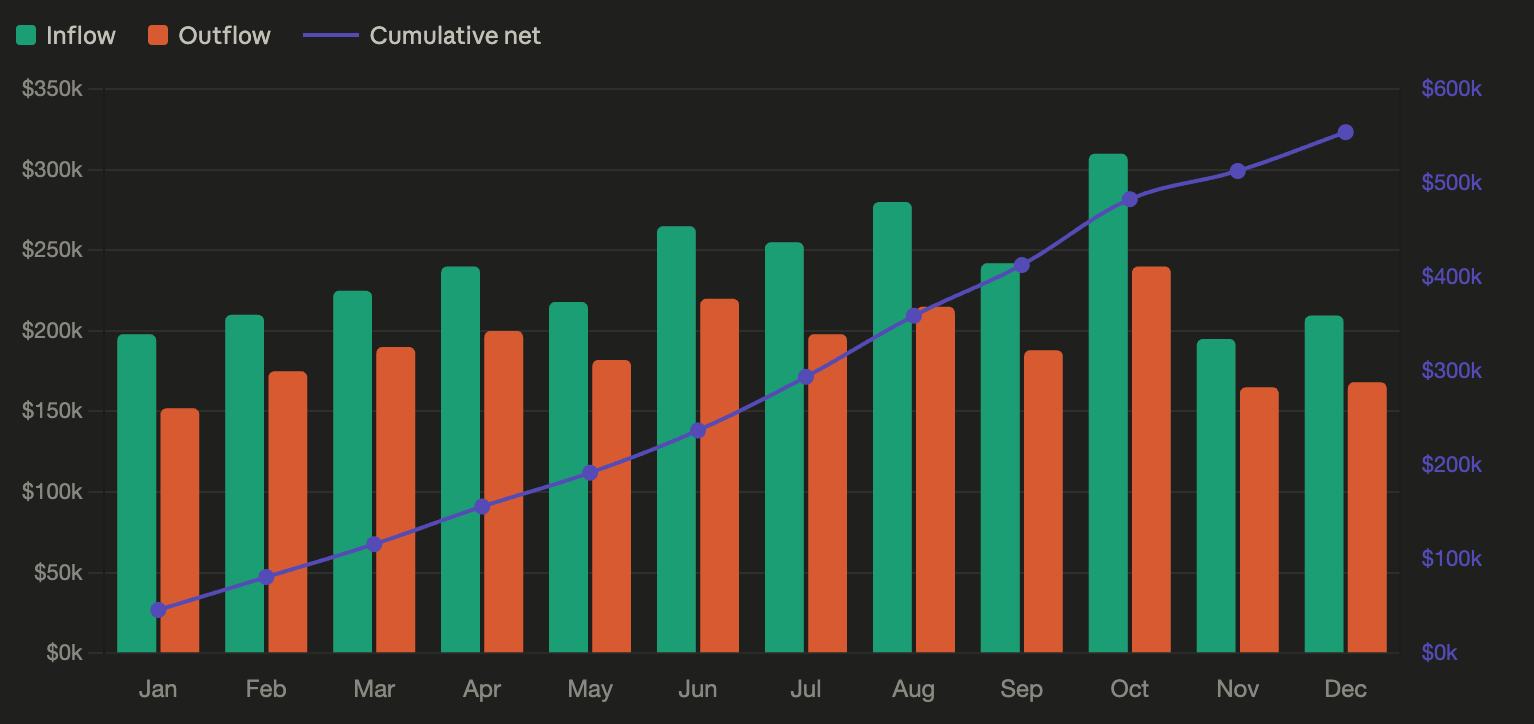
Rekap connects to the banking and payment platforms we use, pulls the data continuously, normalises everything into our reporting currency, and lets us ask questions about it in plain language. Instead of opening four tabs, we ask: how much cash do we have in IDR right now, across all accounts. We get an answer in seconds.
It isn't magic. It is the data that already existed, stitched together properly, with a query layer on top. The reason a tool like this didn't exist for us before is the same reason it doesn't exist for most small companies. Building it wasn't anyone's main job.
For us, building tools is the main job. So we built it.
We aren't ready to make grand claims. We run Oddbit on it. We use it every day. It answers the question we opened this article with in under a second. That is about as far as we'll go today.
Why we wrote this article
If you recognised yourself at any point in the first half of this article, you are not alone, and you are not doing anything wrong. Most companies your size live with the same quiet friction. Most of us just haven't sat down to count what it costs.
In the next piece in this series, we'll show what a week of running a small company on a tool like this actually looks like, including the boring parts.
And if you're running something, and you'd like a team that builds like this, we'd love to hear about it.